This slideshow requires JavaScript.


Hong Kong (香港; “Fragrant Harbour”), officially known as Hong Kong Special Administrative Region of the People’s Republic of China, is a city state with a high degree of autonomy on the southern coast of China at the Pearl River Estuary and the South China Sea. Hong Kong is well known for its expansive skyline, deep natural harbour and extreme population density (some seven million inhabitants over a land mass of 1,104 km2 (426 sq mi)). The current population of Hong Kong comprises 93.6% ethnic Chinese. A major part of Hong Kong’s Cantonese-speaking majority originated from the neighbouring Canton province (now Guangdong), from where skilled labour fled after the communist government took over China in 1949 and subsequently purged its population during the 1960s.
After China’s defeat in the First Opium War (1839–42) against the British Empire, Hong Kong became a British colony with the perpetual cession of Hong Kong Island, followed by Kowloon Peninsula in 1860 and a 99-year lease of the New Territories in 1898. After it was occupied by Japan during the Second World War (1941–45), the British resumed control until 30 June 1997. As a result of the negotiations between China and Britain, Hong Kong was transferred to the People’s Republic of China under the 1984 Sino-British Joint Declaration. The city became China’s first Special Administrative Region on 1 July 1997 under the principle of “one country, two systems”.
Towards the late 1970s, Hong Kong became established as a major entrepôt between the world and China. The city has developed into a major global trade hub and financial centre, and is regarded as a world city and one of the eight Alpha+ cities. It ranked fifth on the 2014 Global Cities Index after New York City, London, Tokyo and Paris. The city has one of the highest per capita incomes in the world, and the most severe income inequality among the advanced economies. It has a high Human Development Index and is ranked highly in the Global Competitiveness Report. Hong Kong is the third most important financial centre after New York and London. The service economy, characterised by low taxation and free trade, has been regarded as one of the world’s mostlaissez-faire economic policies, and the currency, the Hong Kong dollar, is the 13th most traded currency in the world.
Limited flat land created a necessity for dense infrastructure, and the city became a centre of modern architecture, earning Hong Kong the title as one of the world’s most vertical cities. Hong Kong has a highly developed public transportationnetwork covering 90 percent of the population, the highest rate in the world, and it relies on mass transit by road or rail. Air pollution remains a serious problem. Loose emissions standards have resulted in a high level of atmospheric particulates.



A Haloween Party in one of Jakarta Malls, October 2013.







A random test of fuji x-trans cmos sensor result so far.












Working project.. still in progress.















Its the 66th birthday of Indonesia Air Force.

















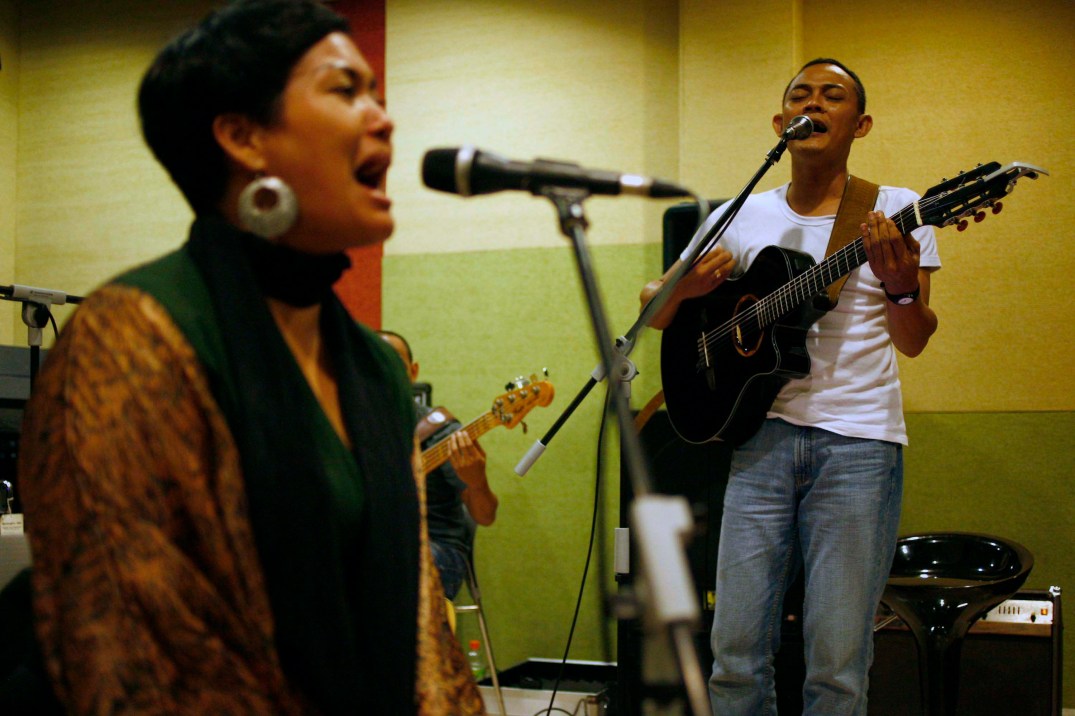
“Small miracles / they’re making small miracles / from the birth of a child ’till he learns how to walk / small miracles / thank God I’m alive.…”
Bonita and the Hus Band believe in small miracles.
As they put it in the song “Small Miracles”, the group, which classifies its music as folk pop, said that having faith in small wonders makes dreams come true. In the same spirit, they formed the band in 2006.
With her husband, Petrus Briyanto Adi (Adoy) as lead guitarist, Bharata Eli Gullo (Bharata) on percussion and Jimmy Tobing (Jimmy) on saxophone, singer Bonita creates fresh acoustic folk songs.
Bonita comes from a strong musical background. Her powerful vocals won her the Southeast Asia singing contest, Asia Bagus, in 1994, which came as no surprise given her parents’ strong influence.
Her mother, Herdawati was a jazz singer when she married her father, legendary Indonesian emcee and singer, Koes Hendratmo. Her brother, Hendra Perdana or Anda is also a musician with a couple of hits that still echo with Indonesian music fans.
Getting married to Adoy brought deeper maturity to Bonita’s music.
“Adoy makes me see life in a more positive way. He helps me create positive lyrics,” she said. The group’s songs are mostly talk about hope, love and dreams.
As one of the founding members of indie band Cozy Street Corner in 1996, Adoy’s passion to create new tunes and fresh new Indonesian music has been a strong driving motivation throughout his life.
The band first got its name from popular host, Farhan, in a show at a cafe in Kemang, South Jakarta, at the end of 2006. Farhan introduced Bonita and her band, consisting of her husband and his two buddies, as Bonita and the Hus Band, a spontaneous play on her spouse’s participation in the band.
“To deliver a positive message through our songs is the reason we created the band,” said Adoy.
Their concert, titled Small Miracles, is scheduled for Feb. 1 at Graha Bhakti Budaya, Taman Ismail Marzuki, Central Jakarta. It will be the second for Bonita & the Hus Band after their first official concert last year in Salihara Theater, South Jakarta.
“We started with a dream and no money in our pocket, but it has gone well. It’s truly a small miracle,” said Bonita.

















 JADIGUNA